
How to Choose the Right Game Controller OEM Factory? (A Guide for Overseas Wholesale & Custom Brands)

For overseas gaming accessory wholesalers, startups, and custom brand owners, finding a reliable gamepad OEM factory is the key to building brand competitiveness, controlling costs, and seizing the global gaming peripheral market. However, most businesses struggle with the same pain points: the market is flooded with gamepad OEM factories of varying quality, making it hard to distinguish reliable partners from unqualified ones. You may encounter factories with insufficient customization capabilities that fail to match your brand’s unique needs, unstable product quality that leads to high return rates, delayed deliveries that disrupt your market launch schedule, or non-compliant products that get banned from overseas markets. Even worse, hidden costs, intellectual property infringement, and poor after-sales service can cause huge financial losses and damage your brand reputation.
Based on the most frequently searched Google search engine optimization keywords by overseas wholesale and custom customers (such as “custom brand gaming controllers OEM factory”, “wholesale gaming controllers OEM/ODM suppliers”, “custom gaming controllers factory with CE and FCC certifications”, “low minimum order quantity gaming controllers OEM manufacturer”), we will address your core pain points and provide you with a step-by-step guide to help you efficiently select the appropriate gaming controllers OEM factory. By following this guide, you can avoid common problems and achieve stable brand growth in the global market.
1. Clarify Your Core Needs First: Avoid These Common Mistakes
Before searching for gamepad OEM factories, clarifying your core needs is crucial to avoid wasting time on mismatched partners. According to Google search data, most overseas wholesale and custom customers fail to find the right factory because they are unclear about their own requirements. Focus on these three key points to improve your search efficiency:
- Define YDefine Your Customization Requirements: The core goal of customizing gamepads for your own brand is to stand out from competitors. You need to clarify specific customization details: Do you need to customize the gamepad’s appearance (color, material, grip), button layout, logo printing, or packaging design? Do you require additional features such as macro programming, motion control, RGB lighting, or back paddles? Do you need it to be compatible with mainstream platforms like Xbox, PS, Switch, PC, or mobile phones? These details directly determine the factory’s R&D and customization capabilities, helping you avoid disputes where the final product does not meet your expectations. As many gamers feedback, the grip comfort and button sensitivity of custom gamepads directly affect the user experience, which is also a core selling point for overseas consumers.
- Confirm Your Order Scale & Wholesale Needs: As an overseas wholesale or custom brand, your order volume is a key factor in selecting a factory. Clarify your Minimum Order Quantity (MOQ), regular order volume, production cycle, and whether you need batch delivery or emergency replenishment. Different OEM factories have significant differences in production capacity and MOQ. For example, some factories only accept large orders (10,000+ units), which are not suitable for small and medium-sized wholesalers or startups; others support small-batch customization (500-5,000 units), which helps reduce your trial risk. At the same time, calculate your wholesale costs and confirm whether the quotation includes mold fees, design fees, certification fees, etc., to avoid hidden costs increasing your budget.
- Understand Compliance Requirements for Your Target Market: Overseas markets have strict compliance and certification requirements for gamepads, which is a prerequisite for your products to enter the market legally. For example, the European and American markets require CE (EN 62368-1 safety standard, EN 301 489-17 EMC requirement), FCC, and FDA certifications; wireless gamepads also need to meet additional radio frequency testing standards. The Southeast Asian market requires compliance with local electronic product regulations; South Korea requires KC certification, and Saudi Arabia requires SASO certification. If the OEM factory does not have the corresponding certifications, your products may be removed from shelves, face administrative penalties, or even legal disputes, resulting in inventory backlogs and economic losses.
2. Core Selection Criteria: 6 Steps to Choose the Right Gamepad OEM Factory
Combining high-frequency Google SEO keywords for overseas wholesale and custom customers (such as “reliable custom gamepad manufacturer”, “gamepad OEM factory for overseas wholesale”, “custom gamepad quality control”), we have sorted out 6 practical selection criteria. These criteria cover compliance, customization, R&D, production capacity, quality control, and service, directly addressing your pain points and helping you find a suitable partner efficiently.
Criterion 1: Prioritize Compliance Certifications – A Deal-Breaker to Avoid Market Risks
Compliance is the lifeline for gamepads to enter overseas markets and the top consideration for overseas wholesale and custom brands. According to industry data, more than 70% of disputes in overseas custom gamepad cooperation are caused by insufficient compliance certifications of OEM factories. Focus on verifying these three types of certifications to avoid pitfalls:
- Corporate & Production Certifications: Verify the factory’s business license and production license to ensure that the production scope includes gamepads and there is no over-range production. Use authoritative platforms to check if the factory has any bad records such as administrative penalties, legal disputes, or environmental violations. Prioritize factories with ISO 9001 quality management system and ISO 14001 environmental certification, as these factories have higher standardized management levels and can better ensure product quality and production stability.
- International Compliance Certifications: According to your target market, check if the OEM factory has the corresponding certifications. For the European and American markets, focus on CE, FCC, and FDA certifications; wireless gamepads need additional RF test reports such as EN 300 328 (2.4GHz band) or EN 301 893 (5GHz band). For the Asian market, focus on KC and PSE certifications; the globally recognized CB certification (based on IEC 62368-1 standard) is suitable for converting to various national market access certifications. Always ask the factory to provide original certifications or official website verifiable screenshots, and reject “verbal commitments” to avoid counterfeit certifications.
- Intellectual Property Certifications: Overseas markets have strict protection of intellectual property rights. If the factory’s gamepad design or core technology involves infringement, your brand will face legal disputes and reputation damage. Check if the factory has independent patents related to gamepads and if it can provide an intellectual property liability exemption agreement to avoid infringement risks in the later stage. Especially for custom gamepads, ensure that the design plan has no infringement risks.
Criterion 2: Match Customization Capabilities – Meet Your Brand’s Differentiation Needs
For overseas wholesale and custom brands, differentiation is the key to market competition, and the factory’s customization capabilities directly determine your brand’s competitiveness. Focus on these three points:
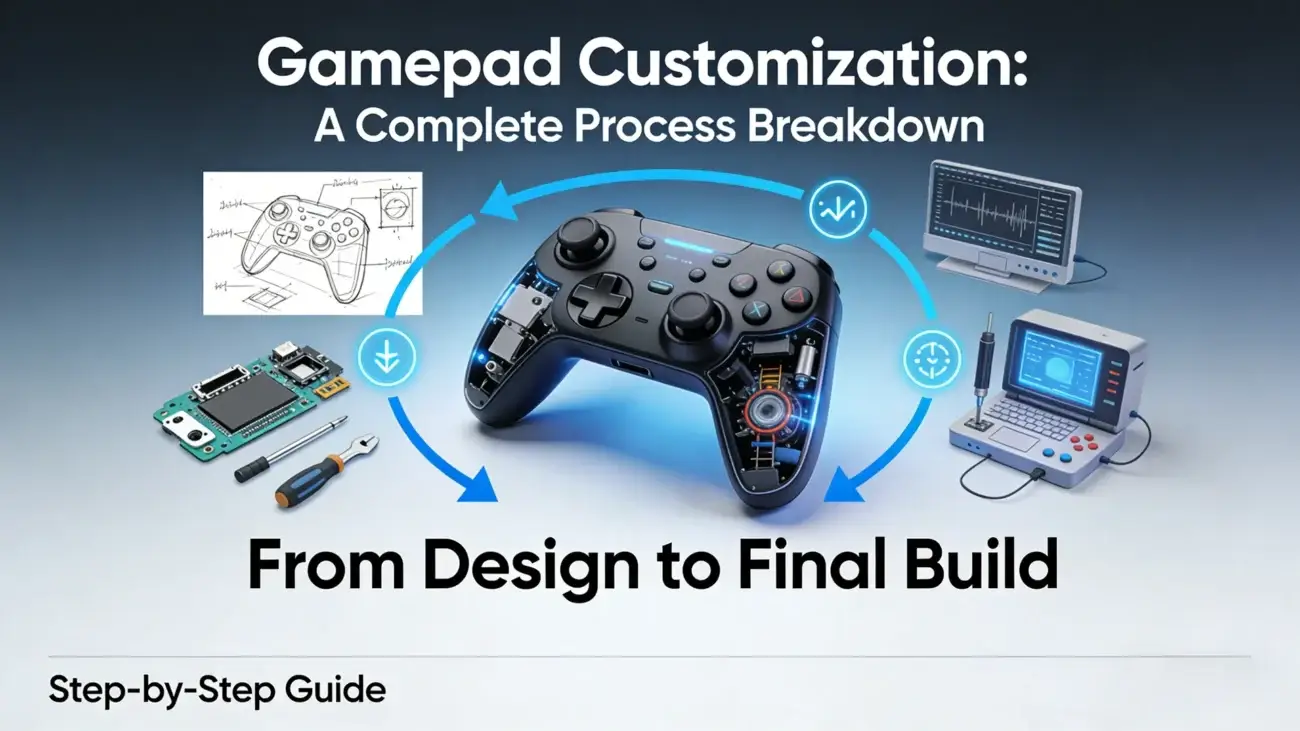
- Full-Process Customization Capabilities: Can the OEM factory provide one-stop customization services from design to mass production? This includes appearance design, button layout optimization, logo/packaging customization, and personalized function development (such as macro programming, motion control, and back paddles). High-quality factories have professional design teams that can optimize customization plans according to your brand positioning and target audience needs. For example, for gamers who play for a long time, they can customize textured grips and ergonomic designs to improve comfort; for e-sports gamers, they can customize adjustable triggers and custom back paddles to enhance operational convenience.
- Cross-Platform Compatibility Customization: With the growing demand for cross-platform gamepads among overseas gamers, can the factory break through the protocol barriers of mainstream platforms such as Xbox, PS, and Switch, and provide custom gamepads with full functionality and plug-and-play convenience? Can it adapt to platform-specific functions according to your needs to avoid compatibility issues? This is a core pain point reported by many overseas brands – some factories’ custom gamepads meet appearance requirements but have poor compatibility, leading to high return rates.
- Sample Customization & Modification Capabilities: Before cooperation, always ask the factory to provide custom samples to verify if the appearance, feel, and functions meet your expectations. At the same time, check the factory’s sample modification capabilities – can it quickly adjust the design and optimize details according to your feedback? High-quality factories usually provide 1-2 free sample modifications to reduce your trial risk.
Criterion 3: Strong R&D Capabilities – Avoid Products Becoming Obsolete After Launch
Game equipment updates rapidly, and the functions and compatibility of gamepads directly affect their market competitiveness. For overseas wholesale and custom brands, the factory’s R&D capabilities determine whether your custom gamepads can keep up with market trends and avoid homogeneous competition. Focus on these two points:
- R&D Team & Strength: Does the factory have a professional R&D team that can keep up with the update rhythm of game equipment (such as the adaptation of PS5 and Xbox Series X/S) and continuously optimize the functions and compatibility of gamepads? Can it develop new custom functions (such as RGB lighting synchronization, wireless fast charging, and voice control) according to market needs to help you create differentiated selling points? At the same time, check the R&D team’s experience – do they have cases of overseas custom gamepad R&D and are they familiar with the demand preferences of overseas markets?
- Technological Iteration & Patent Reserve: Does the factory have continuous technological iteration capabilities to optimize product performance according to industry trends (such as low-latency wireless connection and ergonomic optimization)? Does it have core patents related to gamepads to ensure technological advantages and avoid infringement risks? This is the key to distinguishing high-quality OEM factories from small workshops – small workshops often lack R&D capabilities and can only produce homogeneous, low-configured gamepads that cannot meet custom needs.
Criterion 4: Production Capacity & Delivery Capability – Ensure Stable Bulk Supply
The core demand of overseas wholesale and custom brands is stable bulk supply. If the factory has insufficient production capacity or delayed deliveries, it will directly affect your market launch schedule, leading to stock shortages or backlogs. Focus on these three points:
- Production Scale & Equipment: Conduct an on-site inspection of the factory’s production workshops, the number of production lines, and whether it has automated production equipment (such as button lamination machines and AI visual inspection equipment). The advanced level of equipment directly affects production efficiency and product qualification rate. High-quality factories have a complete production chain from raw material processing and component assembly to finished product testing, without outsourcing processing, which avoids quality control issues and delivery delays. At the same time, understand the factory’s monthly production capacity to ensure it can meet your bulk order needs, especially during peak seasons.
- Delivery Cycle & Performance Rate: Clarify the factory’s standard delivery cycle (e.g., 10-20 working days for regular custom orders, 5-7 working days for urgent orders) and require the liability for delayed delivery to be specified in the contract. At the same time, understand the factory’s delivery performance rate through past cooperation cases and check its supply chain stability – for example, whether it has safety stock of common raw materials (such as joysticks, chips, and micro switches) and whether it has diversified logistics cooperation channels to assist you in handling customs clearance and transportation, shortening the delivery cycle.
- Order Flexibility & Replenishment Capability: The overseas market demand fluctuates greatly – can the factory quickly respond to small-batch replenishment or order adjustments according to your needs? For small and medium-sized wholesalers, order flexibility is particularly important to avoid inventory backlogs. For large-scale wholesalers, ensure the factory has sufficient production capacity reserves to avoid “large-order out-of-stock” issues.
Criterion 5: Comprehensive Quality Control System – Avoid Poor-Quality Products Damaging Your Brand
The quality of gamepads directly affects overseas consumers’ purchasing intentions and your brand reputation. For wholesale and custom brands, poor-quality products not only lead to high return and complaint rates but also consume brand credibility and affect long-term cooperation. Focus on the factory’s full-process quality control system:
- Raw Material Quality Control: Does the factory have a strict raw material selection system? Are core raw materials (such as joysticks, buttons, chips, and lithium batteries) from reliable suppliers, and can they provide third-party test reports? Before each batch of raw materials enters the factory, are they tested for electrical safety, mechanical reliability, and other indicators, and are unqualified raw materials firmly rejected? For example, lithium batteries need to comply with the IEC 62133 standard to avoid overcharging and over-discharging risks; joysticks need to undergo wear resistance tests to avoid rapid wear and failure – these are common quality pain points reported by gamers.
- Production Process Quality Control: Are there quality control points set in key production links (such as button lamination, component assembly, and wireless module debugging) with special personnel for inspection and real-time monitoring? Is there a complete production record for product quality traceability? For example, in the button assembly link, the feel and sensitivity of buttons need to be tested to avoid looseness, misoperation, and key jamming; in the wireless module debugging link, the connection stability and latency need to be tested to meet the needs of overseas consumers.
- Finished Product Testing: Does the factory have a professional finished product testing team and equipment? Do finished products undergo 100% inspection or AQL sampling inspection before leaving the factory? Are the testing items comprehensive, including button life testing (more than 1 million presses), wireless connection stability testing, latency testing, compatibility testing, drop testing (150cm concrete surface), and damp-heat cycle testing? At the same time, clarify the product qualification rate standard (preferably not less than 98%) and after-sales guarantee policy to avoid additional costs due to quality issues. For example, some factories’ custom gamepads have problems such as unresponsive back paddles and rapid joystick wear, and slow after-sales response, causing great losses to overseas brands.
Criterion 6: Overseas Service Capabilities – Reduce Cross-Border Cooperation Costs
The biggest difficulty in cooperating with domestic OEM factories for overseas brands is poor communication, slow response, and insufficient cross-border services, which lead to demand misunderstandings and delayed problem-solving, increasing cooperation costs. Focus on these two points:
- Cross-Border Communication & Service Team: Does the factory have a professional foreign trade service team that can provide multilingual communication services (such as English and Spanish) and is familiar with overseas wholesale and custom processes and needs? Can it quickly respond to your inquiries, order queries, and problem feedback to avoid demand deviations due to poor communication? High-quality factories assign exclusive foreign trade contacts to follow up on orders throughout the process, ensuring efficient communication.
- Cross-Border Logistics & After-Sales Support: Is the factory familiar with overseas logistics and customs clearance processes and can it assist you in handling customs clearance and transportation to shorten the logistics cycle and reduce logistics costs? Does it provide comprehensive overseas after-sales support – for example, when products have quality problems, can it provide return, exchange, or repair services, or supply spare parts to reduce your after-sales costs? Some high-quality factories also provide overseas warehousing docking services to further improve delivery efficiency and meet your bulk supply needs.
3. Exclusive Pitfall-Avoidance Guide for Overseas Wholesale & Custom Brands
Combining the most concerned issues of overseas wholesale and custom customers in Google searches, we have sorted out 5 common pitfalls to help you avoid losses caused by choosing the wrong OEM factory. Each pitfall corresponds to real-world cooperation problems and is highly practical:
Pitfall 1: Only Focus on Price, Ignore Hidden Costs: Many OEM factories offer very low quotes but charge hidden costs such as mold fees, design fees, certification fees, and expedited fees later, making the total wholesale cost exceed the budget. Solution: Clarify all cost details before cooperation, write them into the contract, and avoid verbal agreements. At the same time, calculate the mass production cost, compare quotes from multiple factories, and choose those with reasonable quotes and no hidden costs – do not pursue low prices blindly.
Pitfall 2: Trust “High-Quality Samples, Poor-Quality Mass Production”: Some factories provide high-quality samples to win orders but cut corners and simplify quality control processes during mass production, leading to low product qualification rates, such as unresponsive buttons, wireless latency, and appearance defects. As some overseas gamers feedback, some custom gamepads have exquisite appearances but suffer from unresponsive back paddles and key jamming after a short period of use, seriously damaging brand reputation. Solution: After small-batch trial production, conduct random sampling tests to confirm that the mass production quality is consistent with the samples. Specify the product qualification rate standard and liability for breach of contract in the contract – unqualified products can be returned, exchanged, or compensated.
Pitfall 3: Ignore Platform Compatibility Certifications: If custom gamepads do not pass the compatibility certifications of mainstream platforms such as Xbox and PS, they cannot be sold on these platforms, leading to inventory backlogs. Solution: Confirm in advance that the OEM factory has the corresponding platform adaptation capabilities and certifications to avoid affecting market launch. At the same time, ask the factory to provide adaptation test reports to ensure that the gamepad functions are not阉割
and work normally.
Pitfall 4: Do Not Sign Formal Contracts & Confidentiality Agreements: Some brands save time by not signing formal contracts with OEM factories or not signing confidentiality agreements, leading to order disputes and custom design leaks. Solution: Sign a formal contract before cooperation, clarifying custom requirements, delivery cycles, quality standards, cost details, and liability for breach of contract. At the same time, sign a confidentiality agreement stipulating that the factory shall not disclose core information such as brand designs and custom plans to avoid intellectual property leak.
Pitfall 5: Neglect After-Sales Support: Overseas after-sales costs are high and cycles are long. If the factory has no comprehensive after-sales support, you will face great after-sales pressure and economic losses when products have quality problems. Solution: Clarify the factory’s after-sales policy before cooperation, including return and exchange processes, repair cycles, and spare parts supply. Prioritize factories that provide overseas after-sales support to reduce after-sales costs and communication costs.
4. Conclusion: Choosing the Right OEM Factory is the Accelerator for Your Brand’s Global Expansion
For overseas wholesale and custom brands, choosing the right gamepad OEM factory is all about “matching needs, avoiding risks, ensuring quality, and stabilizing supply”. You don’t need to pursue the “largest or most well-known” factory – focus on those with “complete compliance, strong customization capabilities, comprehensive quality control, and thoughtful service”. Conduct small-batch trial production to verify, then gradually expand cooperation – this can not only reduce trial risks but also steadily build your brand’s competitiveness.
Currently, the demand for custom gamepads in the overseas market is growing continuously, especially for differentiated, high-quality custom gamepads, which have a large market gap. Choosing the right OEM factory allows you to stand out in the fierce market competition with products that meet overseas consumers’ needs. At the same time, through the precise layout of Google SEO long-tail keywords, you can attract more potential customers and achieve bulk order growth.
If you are an overseas wholesale or custom brand and still have specific questions (such as target market compliance certifications, custom plan optimization, or OEM factory selection), feel free to leave a comment and share your brand positioning, order scale, and custom needs. We will provide you with targeted OEM factory selection suggestions and custom plans.