

How to Choose the Right Game Controller Manufacturer? A Practical Guide for International Brands Struggling to Find Reliable Suppliers

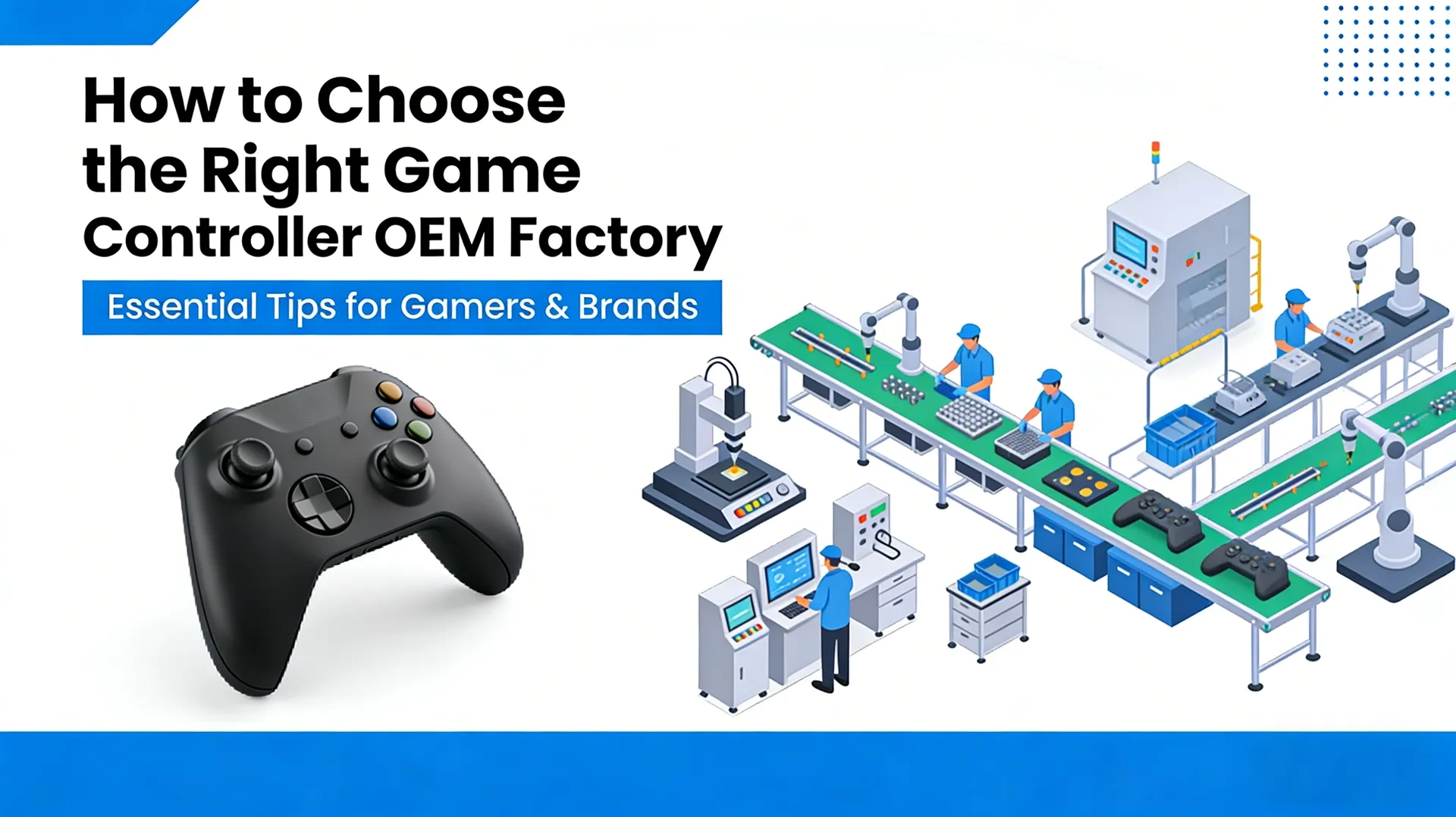
Are you an international gaming brand looking to customize your own line of controllers, but finding it difficult to identify trustworthy suppliers? You’re not alone. For every successful private-label gaming brand on Amazon or Shopify, dozens struggle behind the scenes with the same challenge: how to find a manufacturing partner who delivers quality, communicates clearly, and doesn’t disappear after taking the deposit.
The global gaming peripherals market continues to expand rapidly, and the barriers to launching your own brand have never been lower—provided you know how to navigate the complex landscape of OEM and ODM manufacturing. This guide consolidates the latest 2025-2026 sourcing data to help you cut through the noise and find a partner who can turn your controller vision into reality.
This is the table of contents for this article
- 1. Where Should You Source? Understanding China’s Manufacturing Ecosystem
- 2. A Four-Dimensional Framework for Evaluating Suppliers
- 3. Critical Metrics That Separate Professionals from Amateurs
- 4. The Three Deadliest Traps for International Brands
- 5. Protecting Yourself: The Critical IP and Contractual Considerations
- 6. Sample Policy and Quality Verification
- 7. Action Plan: Your Step-by-Step Roadmap
- – Frequently Asked Questions
- –Conclusion: Building Long-Term Partnerships
## 1. Where Should You Source? Understanding China’s Manufacturing Ecosystem
If you’ve started searching for suppliers, you’ve likely noticed that most roads lead to Guangdong Province, China. This isn’t coincidence—it’s the global epicenter of gaming peripheral production .
*Shenzhen (Innovation & Speed): Known as the “hardware Silicon Valley,” Shenzhen excels in rapid prototyping and new technology integration. If your product requires deep customization—like Hall effect joysticks, low-latency Bluetooth 5.3, or custom firmware—Shenzhen suppliers should be your first stop. The city’s ecosystem thrives on vertical integration, with many manufacturers controlling everything from PCB fabrication to final assembly in-house .
*Guangzhou (Scale & Value): Guangzhou and its surrounding areas host numerous mid-to-large assembly plants with mature supply chains and cost-control expertise. This region is ideal for brands needing stable medium-volume production (5,000-20,000 units) .
*Dongguan (Precision & Quality): Home to many Taiwanese and Hong Kong-invested enterprises, Dongguan specializes in precision molds and injection molding. Suppliers here typically maintain rigorous quality control systems, making them suitable for brands prioritizing premium build quality .
*Taiwan and Hong Kong (Precision Engineering & Trade): Taiwan excels in high-precision electronic components and patented technologies, ideal for premium-grade gaming hardware. Hong Kong serves as a strategic nexus for international trade compliance and cross-border logistics .
## 2. A Four-Dimensional Framework for Evaluating Supplier
For startup brands, you need to look beyond factory size and focus on compatibility. Build your evaluation model around these four dimensions:
| Dimension | Key Indicators | What It Means for Your Brand |
| Technical Capability | R&D team strength, customization experience, SMT lines, ESD-safe workstations | Can they modify firmware (button mapping, macro programming), adjust feel (conductive rubber hardness, micro-switch models), and handle different wireless protocols? Beware of pure assembly shops that only swap shells. |
| Operational Reliability | On-time delivery rate, response time, reorder rate | According to 2025-2026 procurement data, top suppliers maintain on-time delivery rates above 98% . Aim for suppliers responding within 4 hours—this indicates strong communication protocols. A low reorder rate (<15%) suggests high initial product satisfaction. |
| Quality & Compliance | ISO 9001, CE, FCC, RoHS, factory audits | Don’t just look at certificates—request test reports for similar products. CE (Europe) and FCC (US) are mandatory. For environmental requirements, RoHS is the minimum threshold. Request video walkthroughs of production lines or third-party inspection reports |
| Flexible Production | Minimum Order Quantity (MOQ), sample policy | This is the most painful point for startups. Many Shenzhen suppliers now accept samples as low as 1-5 pieces, and even support small trial runs (100-500 units) . Look for partners willing to grow with you, not factories demanding you take 10,000 units upfront. |
## 3. Critical Metrics That Separate Professionals from Amateurs
Beyond general impressions, here are quantifiable indicators you should request from potential suppliers:
– On-time delivery rate: Aim for ≥97%. Delays disrupt inventory planning and damage customer trust .
– Response time: Suppliers responding within ≤4 hours demonstrate operational agility and customer focus .
– Reorder rate: A low reorder rate (<15%) indicates high initial product satisfaction and fewer defects . Some exceptional suppliers achieve rates as high as 60-86%, suggesting strong post-sale support .
## 4. The Three Deadliest Traps for International Brands
Trap #1: Chasing the Lowest Price
Surface level: A factory quotes 30% below industry average.
Reality: This often means inferior ABS plastic (prone to yellowing and cracking), substandard batteries (swelling risk), or omitted EMI shielding (signal interference). Purchase cost is just the tip of the iceberg—after-sales support and brand reputation damage are the real costs .
Trap #2: Neglecting Firmware and Long-Term Support
Surface level: Samples test fine, but after mass shipment, players report incompatibility with new phone OS updates.
Reality: You’ve likely chosen a hardware assembler without software iteration capability. Ensure your manufacturer has ongoing firmware development and support capabilities—critical for post-launch success .
Trap #3: Falling for “We Supply Major Brands” Claims
Surface level: “We make controllers for [famous brand].”
Reality: This may mean you’re getting the same generic mold design they sell to everyone, with zero differentiation and potential IP infringement risks. Startup brands need partners who protect your intellectual property and sign NDAs, not factories selling the same solution to every buyer .
Surface level: A factory quotes 30% below industry average.
## 5. Protecting Yourself: The Critical IP and Contractual Considerations
When you’re building a brand, your product design and technology are your most valuable assets. Here’s what you must address:
Intellectual Property Risk Mitigation
The hard truth: Under current legal frameworks, if your contracted manufacturer produces controllers that infringe on someone else’s patent, you can be held liable as the “manufacturer” —even if you didn’t physically make them . Courts have consistently ruled that placing your brand name, logo, and address on a product makes you legally responsible as a producer .
Case in point: In a 2019 Ningbo court case, a brand that only provided its trademark while the supplier handled all design and production successfully used “legal source” defense to avoid liability. However, another brand that specified technical requirements and participated in quality verification was ordered to pay 500,000 RMB in damages alongside its supplier .
Practical Steps to Protect Your Brand
1. Conduct FTO (Freedom to Operate) searches before finalizing your design. This identifies potential patent conflicts before you commit to tooling .
2. Specify in your contract that the supplier warrants their design doesn’t infringe third-party rights and will indemnify you if it does .
3. Distinguish between OEM and ODM clearly:
– ODM (Original Design Manufacturing): The supplier provides the design; you provide branding. This positions you more as a distributor, potentially enabling “legal source” defenses if patent issues arise .
– OEM (Original Equipment Manufacturing): You provide the design; they manufacture. Here, you’re more likely to be considered a co-manufacturer .
4. Avoid deep technical involvement in the manufacturing process documentation if using ODM—courts may interpret this as co-manufacturing .
## 6. Sample Policy and Quality Verification
Samples aren’t free—and that’s normal. Most reputable suppliers charge $50–$150 per unit to cover setup and shipping. This fee is often credited toward future bulk orders. Be cautious of suppliers offering completely free samples without qualification—they may lack genuine production capabilities .
Sample timelines:
– Standard units: 3-7 days
– Complex prototypes requiring new molds or software: 10-20 days
– Air shipping adds 5-10 days internationally
Quality verification steps:
1. Order prototypes to assess build quality, switch feel, and firmware behavior .
2. Conduct 72-hour aging tests for wireless models .
3. Verify mechanical stress testing (drop, wear, button cycle) documentation .
4. Confirm compliance documentation (CE, FCC) is provided .
## 7. Action Plan: Your Step-by-Step Roadmap
1. Prepare a detailed requirements document: Include precise dimensions, materials (e.g., ABS+PC), colors (Pantone codes), button layout, connectivity (Bluetooth 5.3/2.4G), battery capacity, and required certifications.
2. Cast a wide net, then filter rigorously: On B2B platforms, identify 3-5 candidates using the “Four-Dimensional Framework” above. Prioritize suppliers with reorder rates above 40% , transparent communication, and documented quality processes .
3. Pay for samples—don’t demand freebies: Willingness to pay sampling fees demonstrates seriousness and filters out shell companies. Subject samples to destructive testing, feel blind tests, and extended aging trials.
4. Verify through video or third-party audits: If you can’t visit in person, request live video walkthroughs of production lines and QC processes. Confirm they have SMT lines, injection molding workshops, and independent testing labs .
5. Negotiate transparent terms: Use secure payment methods (Alibaba Trade Assurance or escrow). Define Incoterms clearly—FOB Shenzhen is common and gives you control over freight .
6. Scale gradually with partial shipments: For first-time collaborations, request partial deliveries to test logistics and market response before committing to full volumes .
## Frequently Asked Questions
Q: How can I verify a manufacturer’s reliability without traveling to China?
A: Cross-check supplier claims with video audits or third-party inspections. Analyze transaction history—consistent on-time delivery (>95%) and quick responses (<4h) reflect operational stability. Always test physical samples before mass production .
Q: Do suppliers support firmware customization?
A: Yes, many offer programmable macros, vibration tuning, and button remapping. Submit detailed technical briefs and expect non-recurring engineering (NRE) charges for complex changes .
Q: What warranty should I expect?
A: Standard industry practice is 12 months warranty. Reputable suppliers will repair or replace defective items during this period .
Q: Can manufacturers ship directly to Amazon FBA?
A: Yes, many experienced suppliers routinely handle direct-to-FBA shipments for international clients .
Q: What’s the difference between a trading company and a manufacturer?
A: Manufacturers own production facilities and equipment; trading companies act as intermediaries. While some trading companies provide valuable services, manufacturers typically offer better pricing, direct quality control, and deeper technical knowledge .
## Conclusion: Building Long-Term Partnerships
Choosing a game controller manufacturer isn’t just about finding the cheapest option—it’s about identifying partners who align with your brand’s standards for quality, reliability, and innovation. Whether you prioritize scale, speed, or specialization, the key lies in thorough vetting, clear communication, and ongoing performance monitoring.
By focusing on verified metrics, conducting hands-on evaluations, and understanding the trade-offs between cost and value, international buyers can establish sustainable supply chains that support growth, protect margins, and deliver exceptional end-user experiences.
Start with small trial orders, leverage digital verification tools, and gradually scale partnerships with suppliers who consistently meet or exceed expectations. In the dynamic world of gaming hardware, your choice of manufacturer can be the difference between market leadership and missed opportunities .