


Peak Season FBA Warehouse Overload: How Game Controller Wholesalers Avoid Q4 Stockouts

The Q4 FBA Fear Isn’t Selling — It’s Stocking
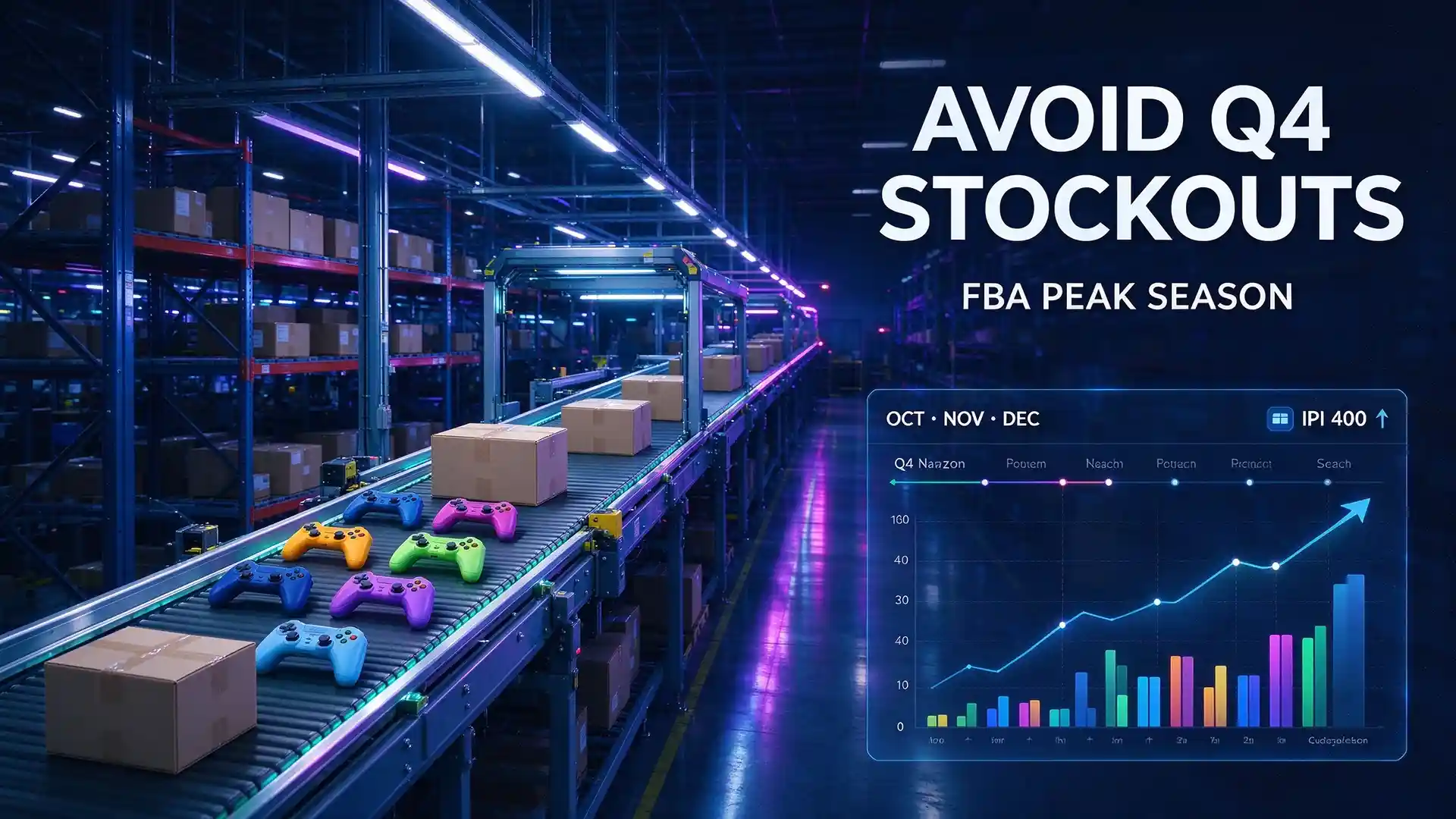
By mid-October, most Amazon sellers aren’t worried about whether customers will buy. They’re worried about whether their inventory will be received, checked in, and live in time for Black Friday. The reality of peak-season FBA is brutal: inbound windows stretch, receiving queues balloon to two to three weeks, and storage limits tighten exactly when you need capacity the most.
For game controller wholesalers — where a three-week miss can erase an entire quarter’s margin — the fix is not simply to ship “as early as possible.” It’s to ship smarter: split-ship across modes and warehouses, stage stock in a 3PL overseas warehouse, and keep a self-fulfillment fallback so you never go dark. Here’s the playbook, built around what the data actually shows.
The FBA Inbound Congestion Timeline (Oct–Dec): What History Shows
Amazon openly states that during the November–December peak it prioritises processing customer orders, which means longer receiving times for inbound shipments. Across recent Q4 cycles, the pattern is consistent:
| Window | What typically happens | Risk level |
| Early October | Storage limits refresh; sellers flood the network. Receiving roughly normal but queues start forming. | Low |
| Late October | Congestion begins — receive times stretch to 1–2 weeks, especially for palletised freight. | Medium |
| Early–Mid November | Worst stretch: receiving can hit 2–3+ weeks right before Black Friday. | High |
| Late Nov–Dec | Customer order volume peaks; Amazon further de-prioritises receiving. | High |
The takeaway is uncomfortable: inventory that ships in October but arrives mid-November can miss the Black Friday window entirely. That’s why the timeline above, not your sales forecast, should drive your inbound calendar.
Amazon’s Q4 Storage Limits: The IPI Threshold That Decides Your Capacity
Amazon sets storage limits each quarter based on your Inventory Performance Index (IPI). The working threshold is 400: an IPI score of 400 or higher keeps you eligible for healthy (often unlimited) storage for standard-size, oversize, clothing and footwear; below 400, you face restricted capacity and storage overage fees.
During Q4, three things collide: your IPI is measured right before the quarter, capacity is most constrained, and you need maximum inventory on hand. If your score dips or one of your storage types is capped, you may not even be able to send the stock you’ve already purchased. That is precisely why wholesalers build redundancy outside Amazon’s network — not instead of it, but alongside it.
Three Strategies to Avoid Q4 Stockouts
Strategy 1 — Split Shipping: Sea in Advance, Air to Top Up
Ship the bulk by sea weeks ahead — it’s lower cost and lands before the congestion builds. Hold a faster air-freight buffer for your best-sellers so you can top up mid-season if one FC slows down. Split the shipment across multiple Amazon fulfilment centres to spread receiving risk instead of betting the whole quarter on one door.
Strategy 2 — 3PL Overseas Warehouse as a Staging Buffer
Park a portion of your Q4 stock in a 3PL overseas warehouse near your market. When Amazon receives quickly, you release more into FBA; when receiving stalls, you keep selling via FBM or replenish Amazon from the 3PL. This is the single biggest lever against a three-week queue — it gives you a second source of truth for inventory.
Strategy 3 — FBF / Self-Fulfilment Fallback
Keep critical SKUs live on a self-fulfilment (FBM/FBF) channel as a fallback. If Amazon receiving stalls in mid-November, you continue selling from your own warehouse — no stockout, no lost Buy Box window, no empty listing during the highest-traffic weeks.
| Approach | Best for | Main cost | Resilience to receiving delays |
| Split shipping (sea + air) | Bulk volume + fast top-ups | Higher freight when air is used | Medium — spreads risk |
| 3PL overseas warehouse staging | Multi-SKU, high-volume catalogs | Storage + pick-pack fees | High — second inventory source |
| FBF / self-fulfilment fallback | Critical / top-selling SKUs | FBM fees + labour | High — keeps you selling |
Why Game Controllers Are Ideal for 3PL One-Piece Dropshipping
Game controllers and accessories have a near-perfect logistics profile: small, light, and high value per unit. That makes them cheap to store and cheap to pick-pack-ship on a one-piece basis — and it keeps you out of the oversized-surcharge traps that hit larger electronics. An indicative unit-cost structure for a 3PL one-piece dropship of a standard game controller:
| Cost component | Typical range (indicative) | Notes |
| Monthly storage (per unit) | $0.05 – $0.15 | Volume-based; controllers are small and stackable |
| Pick + pack (per order) | $0.40 – $0.90 | Often 1–2 controllers per order |
| Shipping label / dunnage | $0.05 – $0.15 | Lightweight packaging |
| Carrier shipping (per parcel) | $4.00 – $8.00 | Depends on zone/weight class; light = cheap |
| Total landed per order | Approx. $4.50 – $9.00 | Competitive vs. stockout risk |
These are indicative ranges to frame the cost model, not fixed quotes — final pricing depends on volume, SKU mix, and carrier contract. The point is that staging Q4 controllers in an overseas warehouse is cheap relative to the margin you lose to a stockout.
Full-Service Support: Labeling, Case Splitting, Multi-Warehouse Allocation
The reason wholesalers lose Q4 is rarely production — it’s the handoffs between manufacturing, prep, and shipping. As a full-stack manufacturer and an authorised partner of PXN (with PowerA and DOBE cooperation), Guangzhou Sundi Electronics has built its Q4 program around exactly those handoffs:
- FBA-ready labelling & prep — barcode, polybag, and carton labelling ready for direct send-to-FBA, reducing FC rejections that stall receiving.
- Case splitting — break master cartons into SKU-matched or mixed boxes so you can route different quantities to different Amazon warehouses from one production run.
- Multi-warehouse allocation — coordinate shipments to multiple Amazon FCs and to 3PL overseas warehouses from the same batch, so your stock is never sitting behind a single queue.
- OEM/ODM flexibility — from mould development to mass production, with MOQ-friendly programs and compliance-ready designs (CE/FCC/RoHS) so your Q4 SKUs are built to ship light and compliant.
One manufacturing partner covering mould → production → labelling → split shipping removes the handoffs where Q4 delays usually live — and gives you a single accountable line of sight from factory floor to marketplace.
Conclusion: Ship Smarter, Not Just Earlier
Avoiding Q4 stockouts isn’t about one early container. It’s about a redundant system: split-shipping across modes and warehouses, a 3PL staging buffer, and a self-fulfilment fallback — backed by a manufacturing partner who can label, split cases, and route to multiple warehouses for you. The queues are predictable. Your inbound plan should be too. Get your Q4 flow in place now, before mid-November decides it for you.
Ready to structure your Q4 inbound plan?
Talk to our team for a free OEM + fulfilment consultation. We’ll map a split-ship and overseas-warehouse staging plan around your Amazon footprint — so your controllers stay in stock when it counts.
FAQ
How early should I send Q4 FBA inventory?
Industry practice is to have Q4 stock received by late September to early October. Inventory that arrives mid-November risks a 2–3 week receiving queue that can miss Black Friday. Split-shipping and a 3PL buffer give you a safety net if timing slips.
What is the IPI threshold for healthy FBA storage?
An Inventory Performance Index (IPI) score of 400 or higher keeps you eligible for healthy (often unlimited) storage. Below 400, you may face storage restrictions and overage fees. IPI is re-measured each quarter.
What is 3PL overseas warehouse dropshipping?
You store inventory in a third-party logistics warehouse near your market; when a customer orders, the 3PL picks, packs, and ships the item in your name (one-piece or in bulk). For game controllers it’s a cost-effective way to keep selling even when FBA receiving slows.
Can you label and split cases for FBA in one order?
Yes. We provide FBA-ready labelling and can break master cartons into SKU-matched or mixed boxes so you can send different quantities to different Amazon warehouses from the same production run.
What’s the minimum order quantity for game controllers?
We offer MOQ-friendly OEM/ODM programs. Volume and mix determine pricing and lead time — contact us with your target SKUs and forecast for a concrete MOQ and quote.