

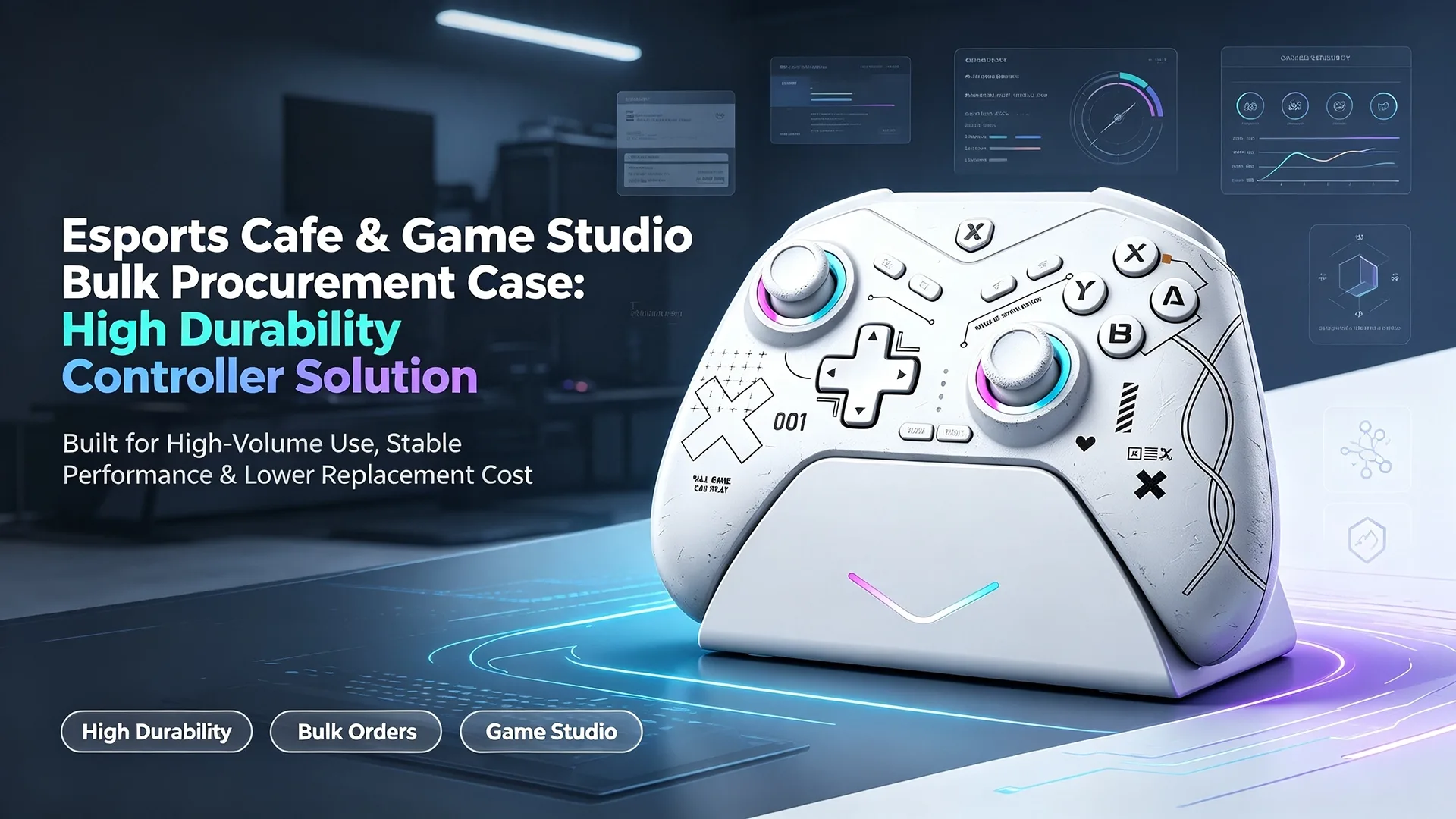
Esports Cafe & Game Studio Bulk Procurement Case: High Durability Controller Solution

For an esports cafe, gaming lounge, game studio, or other commercial gaming environment, game controllers are not used in the same way as controllers purchased for home gaming.
A home user may play for a few hours a week.
A commercial gaming venue may use the same controller repeatedly throughout the day, across different customers, games, and gaming sessions.
This creates a completely different procurement requirement.
For commercial buyers, the most important question is often not:
“What is the lowest controller price?”
It is:
“How much will this controller actually cost us to operate over its service life?”
Frequent joystick drift, worn buttons, damaged cables, inconsistent input, customer complaints, warranty claims, and repeated replacement orders can quickly turn a low-cost controller into a high-cost operating item.
This case study looks at how a commercial gaming business can approach esports cafe game controller bulk procurement through a combination of Hall Effect technology, batch quality control, standardized purchasing, and after-sales support.
The Commercial Gaming Controller Problem
Esports cafes and game studios have several challenges that are different from normal retail customers.
A controller used by one person at home may remain in good condition for a relatively long period.
A controller in a commercial environment may experience:
- Repeated daily use
- Multiple users
- Long gaming sessions
- Frequent plugging and unplugging
- Repeated Bluetooth or wireless pairing
- High-frequency joystick movement
- Heavy trigger usage
- Frequent cleaning
- Accidental drops or impacts
As usage increases, even a small product-quality issue can become a significant operating problem.
For a gaming venue with dozens of controllers, one defective unit is not simply one defective product.
It can mean:
One less playable station + customer complaints + staff time + replacement cost.
Common Problems in High-Frequency Controller Use
1. Joystick Drift
Joystick drift is one of the most frustrating problems for commercial gaming venues.
When a controller begins registering movement even when the joystick is not being intentionally moved, players may experience:
- Character movement without input
- Camera movement
- Menu movement
- Difficulty aiming
- Inconsistent gameplay
For competitive gaming environments, even small input inconsistencies can affect the user experience.
This is why joystick technology should be an important part of commercial controller procurement.
2. Rapid Component Wear
Commercial controllers can experience significantly more usage cycles than home-use products.
The most frequently used components may include:
- Analog sticks
- Triggers
- ABXY buttons
- D-pad
- Shoulder buttons
- Charging ports
- Cables
- Wireless connection components
A controller designed primarily around a low purchase price may not always be the most appropriate choice for a high-frequency commercial environment.
3. High Replacement Frequency
When controllers fail frequently, the procurement department has to repeatedly manage:
- Replacement orders
- Inventory replenishment
- Product inspection
- Staff troubleshooting
- Customer complaints
- Warranty claims
- Shipping
This creates an indirect operating cost.
The controller itself may be inexpensive, but the replacement process is not free.
4. Inconsistent User Experience
Commercial gaming venues need consistency.
If one station has a controller with:
- Different joystick sensitivity
- Different button response
- Different dead zone
- Different connection behavior
customers may notice the difference immediately.
For esports cafes and game studios, consistency across the controller fleet is therefore an important procurement objective.
Why Hall Effect Controllers Are Worth Considering
One of the major hardware options for commercial controller procurement is Hall Effect joystick technology.
Traditional potentiometer joysticks rely on physical electrical contact to measure movement.
Hall Effect joystick systems use magnetic sensing to detect movement.
Because the sensing mechanism differs, Hall Effect technology can help address certain wear-related issues associated with traditional contact-based joystick mechanisms.
However, buyers should not assume that simply using the words “Hall Effect” automatically guarantees a durable commercial controller.
The complete product still depends on:
- Joystick components
- PCB design
- Firmware
- Calibration
- Mechanical structure
- Quality control
- Assembly consistency
- Testing standards
For commercial buyers, the important question is therefore:
How does the complete controller perform under the intended usage conditions?
The Commercial Procurement Solution
For a high-frequency gaming environment, we recommend looking at the controller as part of an overall operating system rather than as an individual product.
A commercial procurement solution can include:
Hardware
- Hall Effect joysticks
- Durable buttons
- Reliable triggers
- Robust housing
- Stable connection hardware
Firmware
- Joystick calibration
- Dead-zone optimization
- Sensitivity configuration
- Platform compatibility
- Stable input recognition
Quality Control
- Component inspection
- Assembly inspection
- Functional testing
- Joystick testing
- Button testing
- Connection testing
- Final inspection
Procurement
- Batch purchasing
- Standardized configurations
- Spare-unit planning
- Scheduled replenishment
After-Sales
- Warranty policy
- Defect handling
- Replacement process
- Technical support
This approach helps transform controller purchasing from a simple price comparison into a commercial operating-cost strategy.
A Typical Esports Cafe Procurement Scenario
Consider a commercial gaming venue that needs controllers for multiple gaming stations.
The buyer may initially compare suppliers based on unit price.
However, after several purchasing cycles, additional problems may become visible:
Low Initial Price
↓
Higher Wear / Failure Risk
↓
More Replacement Units
↓
More Staff Handling
↓
More Customer Complaints
↓
Higher Long-Term Operating Cost
This is why commercial buyers should calculate the total cost of ownership (TCO).
Total Cost of Ownership for Commercial Controllers
A simple calculation can be structured as:
Total Controller Cost = Purchase Cost + Replacement Cost + Shipping + Labor + After-Sales Cost + Downtime Cost
For example, if a controller repeatedly requires replacement, the actual operating cost becomes significantly higher than the original purchase price.
A more durable controller may have a higher initial purchase price but potentially reduce replacement frequency and related operating costs.
The actual result should always be measured using the customer’s own usage and replacement data.
Batch Procurement: Why Consistency Matters
For an esports cafe or game studio, purchasing controllers one batch at a time from different suppliers can create inconsistent products.
Different batches may have different:
- Joysticks
- Firmware
- Button feel
- Sensitivity
- Wireless behavior
- Packaging
- Warranty terms
This creates additional management complexity.
A standardized procurement program can instead define:
One Product Specification → One QC Standard → One Firmware Configuration → One Procurement Process
This makes it easier for staff to manage the controller fleet.
Batch Quality Control for Commercial Orders
For bulk commercial orders, quality control should happen before products reach the gaming venue.
A professional QC process can include:
Appearance Inspection
Check:
- Housing assembly
- Surface finish
- Button alignment
- Logo placement
- Packaging condition
Functional Testing
Check:
- ABXY buttons
- D-pad
- Shoulder buttons
- Triggers
- Analog sticks
- Vibration
- Charging
- Wireless connection
Joystick Testing
For Hall Effect controllers, testing can include:
- Center position
- Movement range
- Input response
- Calibration
- Dead-zone behavior
Platform Testing
Where applicable, test the controller on the actual supported platforms.
This is particularly important when the commercial customer operates multiple gaming platforms.
Firmware Optimization for Commercial Gaming
Hardware durability is only one part of the solution.
Firmware can also be optimized for the intended environment.
For example, commercial buyers may require:
- Consistent joystick response
- Appropriate dead zones
- Stable button mapping
- Platform-specific configuration
- Consistent vibration
- Reliable connection behavior
If the same controller model is deployed across dozens of gaming stations, firmware consistency becomes particularly important.
For brands and commercial customers requiring deeper customization, firmware can potentially be configured according to the target application.
Related Article:
Game Controller Firmware Customization: How to Optimize Gaming Experience for Target Markets
How PLAYX Approaches Commercial Controller Procurement
PLAYX develops game controllers for B2B customers including wholesalers, distributors, gaming brands, and commercial gaming applications.
For commercial procurement projects, the focus can be placed on four areas:
1. Durable Controller Configuration
Suitable controller platforms can be configured with Hall Effect joystick technology and other components appropriate for the intended product positioning.
2. Batch Consistency
Bulk orders can be produced according to an agreed product specification and QC standard.
This helps ensure that controllers deployed across the same gaming venue provide a more consistent experience.
3. Firmware Configuration
Where supported by the selected hardware platform, firmware parameters can be adjusted according to the project requirements.
4. Long-Term B2B Support
Commercial customers can establish an agreed procurement and after-sales process for future replenishment and replacement requirements.
From One-Time Purchase to Long-Term Procurement Program
For a commercial gaming business, the goal should not necessarily be to purchase controllers once.
A more efficient approach can be:
Initial Bulk Order
↓
Usage Monitoring
↓
Failure / Replacement Tracking
↓
Product Evaluation
↓
Scheduled Replenishment
↓
Repeat Bulk Procurement
This creates a more predictable procurement cycle.
It also gives the buyer real data to evaluate whether a controller is actually reducing operating costs.
How to Measure Commercial Controller Performance
Instead of relying only on supplier claims, gaming venues can establish several internal KPIs.
Controller Failure Rate
Track the number of controllers requiring replacement during a defined period.
Replacement Frequency
Measure how often controllers are replaced.
Average Service Life
Track how long each controller remains in active service.
Warranty Claims
Monitor the number and type of after-sales issues.
Station Downtime
Record whether controller problems cause gaming stations to become temporarily unavailable.
Cost Per Active Controller
A useful commercial metric is:
Total Controller-Related Cost ÷ Number of Active Controllers
These measurements allow buyers to compare suppliers based on actual operational performance rather than purchase price alone.
How to Evaluate a Game Controller for an Esports Cafe
Before placing a bulk order, commercial buyers should consider the following.
Durability
Can the controller withstand frequent daily use?
Joystick Technology
Does the product use a joystick technology appropriate for the intended usage scenario?
Firmware
Can joystick response and other supported parameters be optimized?
QC
What testing is performed before shipment?
Consistency
Will subsequent batches follow the same specification?
Warranty
What happens if a batch contains defective units?
Replenishment
Can the same model and specification be supplied again?
Documentation
Can the supplier provide clear product specifications and quality standards?
A Better Way to Compare Wholesale Controller Suppliers
Instead of comparing suppliers only by:
Unit Price
use a broader comparison:
| Procurement Factor | What to Evaluate |
|---|---|
| Unit Price | Bulk quotation and quantity breaks |
| Durability | Hardware and component selection |
| Joystick | Hall Effect or other technology |
| QC | Pre-shipment testing standards |
| Firmware | Configuration and stability |
| Warranty | Coverage and claim process |
| Replenishment | Long-term product availability |
| MOQ | Minimum order requirements |
| Lead Time | Production and shipping planning |
| Customization | Hardware, firmware and appearance |
| Total Cost | Purchase + replacement + after-sales |
This provides a more useful framework for commercial procurement.
Bulk Procurement Data: What Commercial Buyers Should Track
For a real esports cafe or game studio case, the following data should be recorded for each procurement cycle:
Initial Order Quantity: [Verified Quantity]
Controller Model: [Verified Model]
Hall Effect Configuration: [Verified Specification]
Initial Purchase Date: [Verified Date]
First Replenishment Date: [Verified Date]
Replenishment Quantity: [Verified Quantity]
Replacement Rate: [Verified Percentage]
Average Service Period: [Verified Period]
Warranty Claims: [Verified Number]
Estimated Replacement Cost Saved: [Verified Amount]
These figures should be based on actual customer records rather than estimated marketing numbers.
Once sufficient data has been collected, Sundig can turn the project into a quantified case study showing the actual commercial results.
How to Calculate the Actual Cost Reduction
For a commercial customer, cost reduction can be calculated using a simple comparison.
Previous Controller Program
Annual Purchase Cost
Replacement Cost
Shipping Cost
Warranty / After-Sales Cost
Operational Handling Cost
=
Total Annual Controller Cost
Then compare it with the new controller program.
New Controller Program
Annual Purchase Cost
Replacement Cost
Shipping Cost
Warranty / After-Sales Cost
Operational Handling Cost
=
New Total Annual Controller Cost
The difference between these two figures represents the actual procurement and operating cost change.
This is more meaningful than simply comparing two supplier quotations.
Why Long-Term Warranty Matters for Commercial Buyers
A commercial gaming customer cannot treat after-sales service as an optional feature.
When controllers are used continuously, even a small percentage of defective products can create significant operational work.
A clear warranty policy should define:
- Warranty period
- Covered defects
- Excluded damage
- Replacement procedure
- Evidence requirements
- Shipping responsibilities
- Response process
For B2B customers, a clearly defined warranty process can make future procurement much easier.
Related Article:
Game Controller After-Sales & Warranty Risk Management Guide
The Importance of Spare Controllers
Even with a durable controller solution, commercial venues should maintain an appropriate number of spare units.
A simple operational strategy is:
Active Controllers + Backup Controllers
When a controller requires inspection or replacement, staff can immediately replace it with a backup unit.
This helps reduce station downtime.
The appropriate spare ratio depends on:
- Number of gaming stations
- Daily usage
- Controller type
- Customer volume
- Historical failure rate
- Replacement lead time
The ratio should therefore be based on actual operating data rather than a universal percentage.
Building a Long-Term Commercial Procurement Partnership
For an esports cafe or game studio, the ideal supplier relationship goes beyond a single transaction.
A long-term procurement program can include:
Product Standardization
Maintain the same approved controller specification.
Batch QC
Use consistent quality-control standards for each shipment.
Firmware Consistency
Maintain the approved firmware configuration.
Spare Inventory
Plan backup units based on actual usage.
Scheduled Replenishment
Forecast future requirements before inventory becomes critical.
After-Sales Support
Maintain a clear process for defective units and warranty claims.
This approach can help transform controller procurement from reactive replacement purchasing into proactive inventory management.
Commercial Controller Procurement Checklist
Before placing a bulk order, ask:
Product
- Is the controller suitable for high-frequency use?
- Is Hall Effect joystick technology available?
- Are the target platforms confirmed?
- Is the firmware configuration suitable?
Quality
- Is there a documented QC standard?
- Are joysticks individually tested?
- Are buttons and triggers tested?
- Is wireless connectivity tested?
Procurement
- Is the bulk quotation confirmed?
- Is MOQ clear?
- Is replenishment available?
- Is the production lead time clear?
After-Sales
- Is the warranty period clear?
- Is the replacement process documented?
- Are defective-unit procedures clear?
Long-Term
- Can the same specification be reordered?
- Can firmware remain consistent across batches?
- Can spare units be supplied?
- Can the supplier support future volume increases?
Beyond Durability: Building a Better Commercial Gaming Experience
For esports cafes and game studios, controller durability is only one part of the purchasing decision.
The complete solution should combine:
Durable Hardware
- Hall Effect Joysticks
- Stable Firmware
- Consistent QC
- Reliable Supply
- Clear Warranty
- Planned Replenishment
This combination helps buyers evaluate the controller based on its commercial operating value, rather than simply its initial purchase price.
Conclusion: Choose Controllers Based on Operating Cost, Not Just Purchase Price
For commercial gaming environments, a game controller is an operating asset.
When a controller is used repeatedly every day, small differences in durability, joystick technology, firmware stability, QC consistency, and after-sales support can have a meaningful effect on the overall cost of running the business.
For esports cafe game controller bulk procurement, buyers should therefore evaluate:
Durability + Quality Control + Service Life + Warranty + Replenishment + Total Cost of Ownership
rather than focusing only on the lowest quotation.
PLAYX provides Hall Effect game controller solutions and B2B bulk procurement support for gaming businesses, distributors, retailers, and private-label brands.
For commercial projects, the product specification, QC standard, firmware configuration, warranty terms, and replenishment plan can be discussed before mass production.
Looking for a durable game controller wholesale solution for an esports cafe, game studio, or gaming venue? Contact PLAYX to discuss your bulk procurement requirements.